

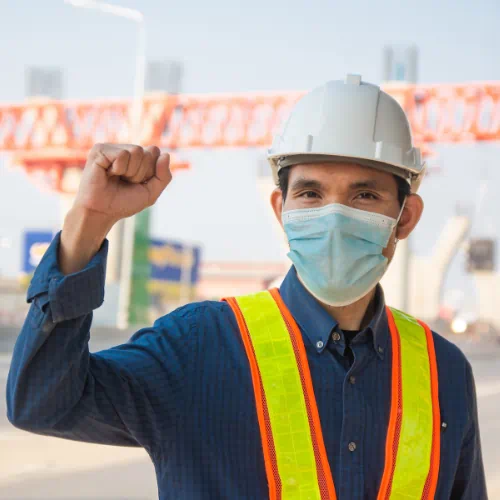
If you work in an environment where respiratory protective equipment (RPE) is required, understanding the face fit testing process is essential. Whether you’re new to the process or refreshing your knowledge before an upcoming test, knowing what lies ahead helps you prepare properly and avoid unnecessary retests.
Face fit testing ensures that the respirator or mask you’re issued actually forms an adequate seal against your face. A mask that fits one person perfectly may be entirely ineffective on another due to differences in facial structure, and that gap in protection can have serious consequences in hazardous environments.
How Long Does Face Fit Testing Take for Operatives on Site?
The duration of a face fit test depends on which method is being used, but most operatives can expect the process to take between 15 and 45 minutes from start to finish. The two main methods are qualitative testing, which relies on the wearer’s sense of taste or smell, and quantitative testing, which uses specialised equipment to measure actual leakage around the mask seal.
Qualitative tests tend to be quicker, often wrapping up in around 20 minutes, whereas quantitative tests can take longer due to the equipment setup and the multiple exercise protocols the wearer must complete. Either way, the process is straightforward, and most operatives find it less daunting than they expected once they understand what each stage involves.
| Test Method | Typical Duration | Equipment Required |
|---|---|---|
| Qualitative (QLFT) | 15 to 25 minutes | Fit test kit, hood, test agent |
| Quantitative (QNFT) | 30 to 45 minutes | Portacount or similar device |
| Initial consultation and briefing | 5 to 10 minutes | None |
| Re-test (if required) | 15 to 30 minutes | Dependent on method |

Need Support? Speak with our Health & Safety Experts today!
Do You Have to Shave Before a Face Fit Test?
This is one of the most frequently asked questions ahead of a face fit test, and the answer is yes, in most cases. Facial hair, even stubble, can significantly compromise the seal between the mask and your skin, meaning the test is likely to fail and, more importantly, that your mask would offer little real-world protection in the workplace.
The Health and Safety Executive (HSE) is clear that a good facial seal is the foundation of effective RPE use, and that facial hair at the sealing surface is a primary cause of mask failure. If you arrive for your test with growth along the seal line, the tester will advise you to reschedule rather than proceed, as the result would be meaningless from a safety standpoint.
What to Bring and What to Wear: Attending a Mask Fit Appointment
Preparation is straightforward, but getting a few things right before you arrive will save time and prevent wasted appointments. You should bring the actual make and model of mask you intend to use in your workplace, as face fit testing is specific to the mask being tested and cannot be transferred to a different model.
Wear the clothing you would normally use on site, as this can affect how the mask sits on your face and whether the headstraps are obstructed. Avoid wearing items like scarves or high-collared garments that might interfere with the seal or the positioning of the mask during the exercises you’ll be asked to perform.
Need Help? Talk to our Professionals now!
Can You Wear Makeup to a Mask Fit Test?
This is a practical concern for many operatives, particularly those who routinely wear makeup to work. The guidance here is to avoid wearing heavy foundation, contouring products, or anything applied along the jawline, cheeks, or around the nose, as these can create a physical barrier between the mask material and your skin.
Light makeup that is kept away from the sealing surface is generally considered acceptable, but it is always worth checking with your testing provider in advance. The priority is that nothing interferes with the ability of the mask to form a complete seal, and the tester will assess this at the start of the appointment before proceeding with the full test.
| Makeup Type | Impact on Seal | Recommendation |
|---|---|---|
| Heavy foundation along jaw or nose | High risk of seal failure | Remove before test |
| Contouring or setting powder on seal area | Moderate risk | Remove before test |
| Light moisturiser (no barrier properties) | Minimal risk | Generally acceptable |
| Eye makeup only (mascara, eyeliner) | No impact on seal | Acceptable |
| Full-coverage base applied to full face | High risk | Remove before test |
What Happens If You Fail a Mask Fit Test?
Failing a mask fit test is more common than many people expect, and it does not reflect poorly on the operative. It simply means that the particular mask being tested does not provide an adequate seal on that individual’s face, which is exactly the kind of information the test is designed to uncover.
If you fail, the tester will typically try a different size of the same mask, or suggest an alternative model that may suit your facial geometry better. In some cases, operatives with certain facial features may need to be fitted with a powered air-purifying respirator (PAPR) or a loose-fitting hood that does not rely on a face seal at all. The Health and Safety Executive recommends that employers ensure every operative using RPE has a valid fit test record for the specific equipment they use on site.ate.
Making the Most of Your Face Fit Test Experience
Understanding what to expect during a face fit test removes the uncertainty from the process and helps operatives arrive fully prepared. From arriving clean-shaven and make-up free around the seal area to bringing the correct mask model, small preparation steps make a significant difference to the outcome and reduce the likelihood of having to rebook.
The face fit test itself is a controlled, professional process carried out by a trained tester who will guide you through a series of exercises such as turning your head side to side, nodding, speaking, and bending forward. These movements replicate what you would typically do in a working environment, ensuring the seal holds under realistic conditions rather than just when standing still.
Employers have a legal duty under the Control of Substances Hazardous to Health (COSHH) Regulations to ensure that RPE is suitable for the wearer, and face fit testing is a core part of meeting that obligation. Investing time in the process protects operatives and ensures businesses remain compliant with current workplace health and safety legislation.
FAQs
A face fit test checks that a tight-fitting respirator forms a reliable seal on a specific individual’s face. It is a legal requirement under UK health and safety regulations for anyone using tight-fitting RPE in the workplace. You can read more background on the subject on the Wikipedia page for respirator fit testing.
There is no fixed legal interval, but retesting is recommended whenever the operative changes mask model, experiences significant changes to their facial structure, or following major weight gain or loss. Many employers schedule reviews every two years as a precautionary measure.
Only tight-fitting masks require fit testing, including disposable filtering facepieces (FFP2, FFP3), half-face respirators, and full-face respirators. Loose-fitting hoods and helmets do not require a face seal and therefore do not need fit testing.
Yes, many occupational health providers offer mobile face fit testing services that come directly to your workplace. This is particularly practical for larger teams or construction sites where scheduling off-site appointments for multiple operatives would be disruptive.
Operatives are typically asked to complete a series of movements including normal breathing, deep breathing, turning the head side to side, moving the head up and down, talking, grimacing, and bending forward. These replicate real working conditions to ensure the seal holds under physical activity.
No, these are two distinct things. A face fit test is a formal assessment carried out by a trained tester using specific equipment or agents, whereas a face fit check is a brief self-check the wearer performs each time they put on their mask to ensure it is seated correctly.
Standard glasses with conventional arms can interfere with the seal of a full-face mask, so this needs to be assessed by the tester. Some providers have specialist frames or lens inserts designed to work within full-face respirators without compromising the seal.
A face fit test certificate is specific to the mask model tested, not the employer, so it can technically transfer if the new employer uses the exact same mask. In practice, many employers prefer to conduct a fresh test to ensure the record is held in-house and current.
In the UK, face fit testers should hold a certificate of competence from an accredited body such as the British Occupational Hygiene Society (BOHS) or the FitTest Register. Employers should verify the credentials of any testing provider before booking appointments.
The tester will issue a written record confirming the mask model, fit factor achieved, and the date of the test. This record should be kept by both the employer and the operative as evidence of compliance, and the Health and Safety Executive recommends it is retained for the duration of the operative’s employment.
Certain conditions affecting the facial structure, such as significant scarring or post-surgical changes, can make it difficult to achieve a seal with standard tight-fitting masks. In these cases, the tester will recommend alternative RPE that does not rely on a facial seal.
Both mask types undergo the same fit testing process, but FFP3 masks offer a higher level of filtration and therefore require a higher fit factor to pass. The test method itself, whether qualitative or quantitative, remains the same regardless of the mask rating.
Costs vary depending on the provider and location, but individual tests typically range from around £25 to £75 per operative. Group bookings at a single site are usually available at a reduced rate, making on-site testing cost-effective for larger teams.
The testing process follows the same principles regardless of mask type, but reusable respirators often offer more adjustment options, which can make achieving a successful fit easier. Disposable masks come in fewer sizes, so operatives with unusual facial profiles may find it harder to pass on a disposable model.